
The Complete JLPT N5 Japanese Course
Learn Japanese through an authored 11-chapter story arc with Yuki and friends. Real dialogues, a voice for every character, and zero subscription fatigue.
Chapter 1 Free · $6.99 Full Unlock · No Subscriptions
Download free, complete Chapter 1 right away, and unlock all 11 chapters for $6.99 whenever you are ready.
Available on iPhone, iPad & Mac
Listen to a Sample Dialogue
音声 · Audio Preview · Chapter 1, Lesson 1Hear how Yuki and Kenji introduce themselves. Real native voice acting, natural conversational pacing, and line-by-line translation.
 Yuki
おはようございます!
Good morning!
 Kenji
おはようございます。ゆきさんですか。
Good morning. Are you Yuki?
- Yuki
はい、そうです。はじめまして、ゆきです。
Yes, that's right. Nice to meet you, I'm Yuki.
- Kenji
はじめまして。けんじです。よろしくおねがいします。
Nice to meet you. I'm Kenji. Pleased to meet you.
- Yuki
こちらこそ、よろしくおねがいします。
Likewise, pleased to meet you too.
Curriculum & Video Lessons
動画 · Video CurriculumCore conversations from Yuki's first days at school. Watch the YouTube video, read the full lesson notes, and replay any line at your own pace.
Chapter 1: First Words
第1章- Episode 1
Japanese Greetings & Introducing Yourself
おはよう・はじめまして
How to say good morning, hello and good evening in Japanese, and how to introduce yourself to someone you are meeting for the first time.
5 linesWatch & Practice → - Episode 2
Sorry & Thank You in Japanese
すみません・ありがとう
How to say sorry and thank you in Japanese: すみません when you get in somebody's way, and ありがとうございます when someone helps you.
8 linesWatch & Practice → - Episode 3
Say Who You Are in Japanese
私は〜です
How to say who you are in Japanese with 私〜です, how to ask a question with か, and how to say what you are not.
10 linesWatch & Practice → - Episode 4
What Is It & Whose Is It
何ですか・だれの
Ask what a thing is and who it belongs to, with the three words Japanese uses for pointing: これ near me, それ near you, あれ over there.
12 linesWatch & Practice → - Episode 5
How to Say "That Hat's Mine Too" in Japanese
この・その・あの・も
Put the thing straight after この, その or あの to name what you are pointing at, say that one is mine too with も, and hear how a brother and sister drop the polite endings.
10 linesWatch & Practice → - Episode 6
Japanese Convenience Store Conversation for Beginners
Understand the five questions a convenience store clerk asks, about your point card, heating your bento, a bag, how you will pay and the receipt, answer them, and catch a price in yen.
27 linesWatch & Practice → - Episode 7
Japanese at the Train Station: What Time, Which Platform
Ask when, what time and which platform at a Japanese train station, catch the answer by ear, and learn the hours and the days of the week.
21 linesWatch & Practice →
Complete 11-Chapter Curriculum
From your very first words to natural everyday conversations. Follow Yuki's school year through the seasons.
Read any grammar explanation freely on the web — or practice the full dialogues with native audio and speech recognition in the app.
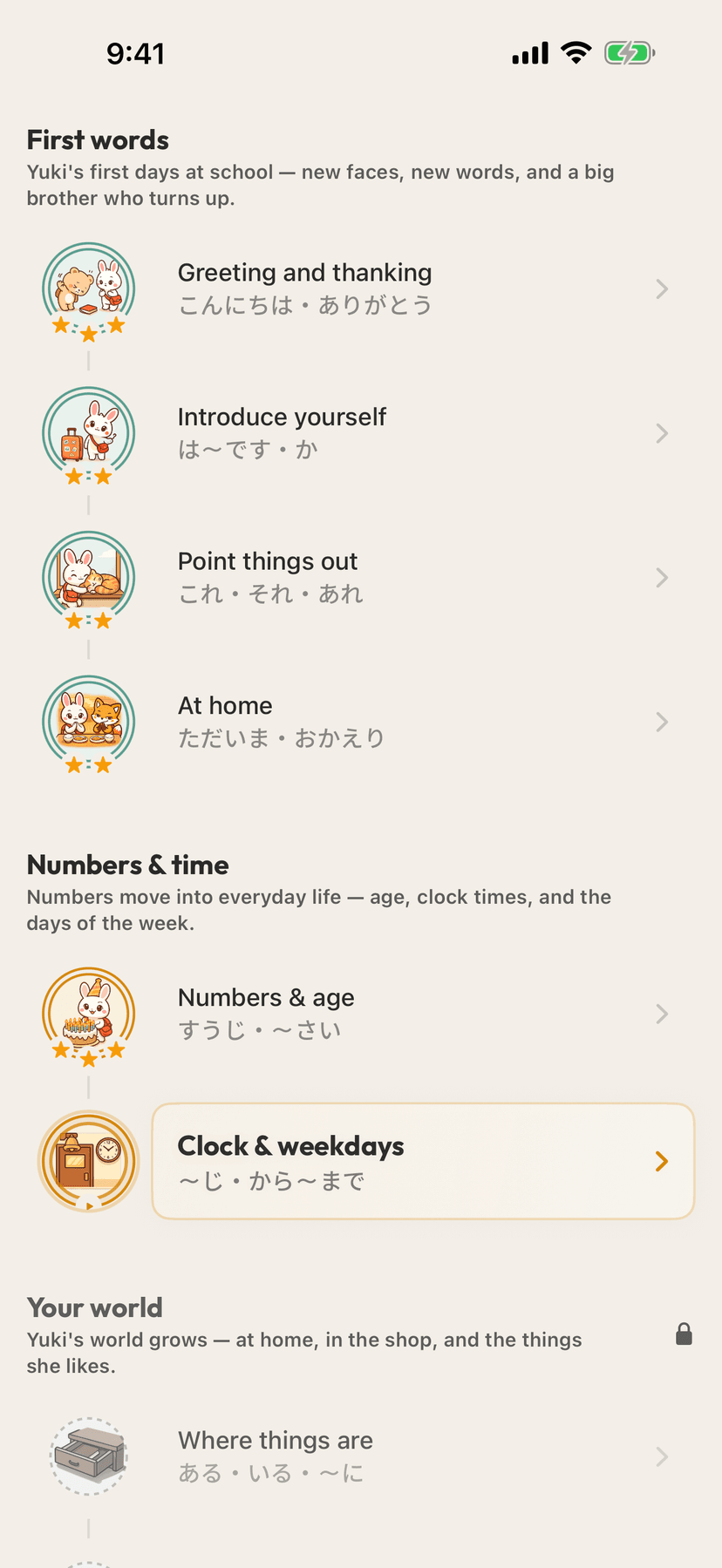
First words
AprilYuki's first days at school — new faces, new words, and a big brother who turns up.
5 lessons14 grammar pointsFree in appGrammar in this chapter
Greeting and thanking
Say hello at any time of day, introduce yourself when you meet someone for the first time, and both say sorry and thank you and reply when someone says them to you.
Introduce yourself
Introduce yourself, check whether someone is who you think, and say what you are not.
- Noun + ですThe Polite Copula: です (Equational sentences & polite identity)
- Topic はTopic Particle: は (The conversational frame & contrastive focus)
- Sentence + かQuestion Particle: か (Sentence-ending question anchor & indefinite compounds)
- Noun の NounNoun Connector & Modifier: の (Possession, classification & pronoun placeholder)
- 〜じゃない / 〜じゃありません / 〜ではない / 〜ではありませんNegative Copula: じゃない / じゃありません (Saying what something isn't)
Point things out
Point things out, ask what they are, and ask whose they are.
- それ + はRefer to a thing near the listener: それ
- これは [noun/description] ですPoint to a thing near you: これ
- あれは [noun/description] ですPoint to that thing over there: あれ
- ... は なに ですかAsking What: なに vs なん (The phonetic laws of 何)
- Sentence + かQuestion Particle: か (Sentence-ending question anchor & indefinite compounds)
- この + [noun]Point to a noun near you: この
- その + nounPoint to a noun near the listener: その
- あの + [noun]Point to something far from both of you: あの
- だれ / どなた + [particle] ... かAsk who someone is (だれ / どなた)
- Noun の NounNoun Connector & Modifier: の (Possession, classification & pronoun placeholder)
- [Noun] も ・ [Question Word] + も + [Negative]Inclusive Particle: も (Also, too, inclusive addition and extreme limits)
- 〜じゃない / 〜じゃありません / 〜ではない / 〜ではありませんNegative Copula: じゃない / じゃありません (Saying what something isn't)
At home
Say the set phrases of a day at home: when you leave and when someone comes back, before and after a meal, a quick sorry to family and friends, and good night.
In the classroom
Get by in the classroom: ask how something is read and what it means, say you do not understand, ask for it one more time, say you have a question, and check that you got it right.
Numbers & time
late AprilNumbers move into everyday life — age, clock times, and the days of the week.
2 lessons13 grammar pointsFull versionGrammar in this chapter
Numbers & age
Count to ninety-nine, say how old someone is, and ask for a phone number.
- [number] + さいSay someone's age: 〜歳 / 〜才
- [number] + ですSay an amount: Quantifiers & Predicates
- Topic はTopic Particle: は (The conversational frame & contrastive focus)
- Noun + ですThe Polite Copula: です (Equational sentences & polite identity)
- ... は なに ですかAsking What: なに vs なん (The phonetic laws of 何)
- Sentence + かQuestion Particle: か (Sentence-ending question anchor & indefinite compounds)
- 0–10 000Count in Japanese: 1 to 10 and pronunciation shifts
Clock & weekdays
Say the time and what day it is, say when something happens, and ask when.
- [hour]じ[minutes]ふん + ですSay what time it is: 〜時 / 〜分
- 0–10 000Count in Japanese: 1 to 10 and pronunciation shifts
- [number] + ですSay an amount: Quantifiers & Predicates
- time word + に (at / on)Pin down exact time: 〜に
- [event] は [time] に はじまります / おわりますStarts and ends: 始まる and 終わる
- いつ + [verb / predicate] かAsk when something happens (いつ)
- Sentence + かQuestion Particle: か (Sentence-ending question anchor & indefinite compounds)
- Topic はTopic Particle: は (The conversational frame & contrastive focus)
- [day]ようび + ですDays of the week: 〜曜日
- Noun + ですThe Polite Copula: です (Equational sentences & polite identity)
- 〜じゃない / 〜じゃありません / 〜ではない / 〜ではありませんNegative Copula: じゃない / じゃありません (Saying what something isn't)
Your world
May into JuneYuki's world grows — at home, in the shop, and the things she likes.
3 lessons28 grammar pointsFull versionGrammar in this chapter
Where things are
Say where things and animals are.
- [Place] に [Noun] が あります/いますExistence Verbs: ある vs いる (Inanimate vs animate existence / Animate intentionality)
- place + に + いる / あるStatic Existence & Target: に (Where things exist & where motion lands)
- [place] の [position] にSpatial position nouns: 上, 下, 前, 後ろ, 中
- どこ = where?Asking Where: どこ, どこか, どこも, どこでも
- Noun と Noun ・ Person と VerbExhaustive Listing & Companion: と (“and”, “with” / The closed set)
- Subject がSubject Particle: が (The grammatical actor and new information)
- Sentence + かQuestion Particle: か (Sentence-ending question anchor & indefinite compounds)
- Topic はTopic Particle: は (The conversational frame & contrastive focus)
- Noun の NounNoun Connector & Modifier: の (Possession, classification & pronoun placeholder)
Shopping in a store
Shop in a small store.
- [item] は いくらですか / おいくらですかAsk how much something costs (いくら / おいくら)
- これは [noun/description] ですPoint to a thing near you: これ
- Topic はTopic Particle: は (The conversational frame & contrastive focus)
- Sentence + かQuestion Particle: か (Sentence-ending question anchor & indefinite compounds)
- noun + を + くださいAsk for an item: 〜をください
- sentence + ねInvite agreement or soften a statement (ね)
- sentence + よAssert new information or emphasize your point (よ)
- たかいです/やすいですReact to a price: 高い, 安い, and diplomatic softeners
- [number] + ですSay an amount: Quantifiers & Predicates
- 0–10 000Count in Japanese: 1 to 10 and pronunciation shifts
- [Noun] も ・ [Question Word] + も + [Negative]Inclusive Particle: も (Also, too, inclusive addition and extreme limits)
- この + [noun]Point to a noun near you: この
- [number] + えんSay a price: 〜円
- [number] + ひゃく / せんSay big numbers: 百, 千, and 万
- あの + [noun]Point to something far from both of you: あの
- あれは [noun/description] ですPoint to that thing over there: あれ
Liking & being able
Say what you like and what you can do.
- [Noun] が 好きです / 嫌いですExpressing Likes & Dislikes: が好き (Liking, preference & why が marks the target)
- とても + [adjective]Say 'very': とても
- [noun] が できる / できますSay you can do something (ができる)
- [noun] が 上手です / 下手ですSay someone's good at something (上手・下手・得意・苦手)
- Topic はTopic Particle: は (The conversational frame & contrastive focus)
- [topic] は どうですか / どう思いますかAsk how something is or what someone thinks (どう / いかが)
- Sentence + かQuestion Particle: か (Sentence-ending question anchor & indefinite compounds)
- Subject がSubject Particle: が (The grammatical actor and new information)
Describe & do
June, the 梅雨 rainsWords pick up colour and speed — describing things and saying what you do.
4 lessons17 grammar pointsFull versionGrammar in this chapter
Describing things (i-adj)
Describe how things are, and how they were.
Describing things (na-adj)
Describe places and people, and tell the two kinds of adjective apart.
Everyday verbs (ます)
Say what you do — politely to a teacher, casually to a friend — and say from when until when.
- [verb stem] + ますThe Polite Verb Form: 〜ます (丁寧語)
- RU-verb, U-verb, or irregular?The three verb families: Godan, Ichidan, and Irregular
- [hour]じ[minutes]ふん + ですSay what time it is: 〜時 / 〜分
- time word + に (at / on)Pin down exact time: 〜に
- [starting point / time / clause] + からThe Starting Point: から (Starting coordinate in space, time & reason)
- [end point / limit / time] + までThe Destination Limit: まで (Ending coordinate in space, time & scope)
- [day]ようび + ですDays of the week: 〜曜日
- Noun + ですThe Polite Copula: です (Equational sentences & polite identity)
Where & how often
Say where, when and how often you do things.
- place + で (where an action happens)Mark where an action takes place: 〜で
- Noun + を + VerbDirect Object Marker: を (The target of action and paths of motion)
- time word + に (at / on)Pin down exact time: 〜に
- [frequency word] + [verb phrase]Say how often you do things: Frequency Adverbs
- [verb stem] + ますThe Polite Verb Form: 〜ます (丁寧語)
Out into town
JulySchool's out and the four part at the gate — and the next day they meet at the station, all heading the same way by three different means.
2 lessons9 grammar pointsFull versionGrammar in this chapter
Where are you off to?
Say where you're going, ask where someone else is going, and say you're heading home.
- [destination / direction] + へ + [motion verb]The Directional Vector: へ (Heading, journey & open horizons)
- いきます・きます・かえりますSay you are going, coming, or returning: 行く, 来る, 帰る
- どこ = where?Asking Where: どこ, どこか, どこも, どこでも
- Sentence + かQuestion Particle: か (Sentence-ending question anchor & indefinite compounds)
- Topic はTopic Particle: は (The conversational frame & contrastive focus)
- [Place] に [Noun] が あります/いますExistence Verbs: ある vs いる (Inanimate vs animate existence / Animate intentionality)
- place + に + いる / あるStatic Existence & Target: に (Where things exist & where motion lands)
With whom, and how?
Say what you're travelling by and who you're going with.
Count & compare
mid-July, the last week of termThe day before the outing and the day of it — a packing list that will not add up, and a market where everything gets measured against everything.
2 lessons11 grammar pointsFull versionGrammar in this chapter
How many?
Count things and people with the right counter, say roughly how much, and say what you have.
- [number] + [counter]Count things and people: The counter system (助数詞)
- thing + が あります (I have)Say what you have: [Owner] は [Item] が ある / いる
- [amount] ぐらいApproximate amounts: 〜ぐらい / 〜くらい
- number + じかん (hours) · 〜ぐらい (about)Elapsed time: hours, minutes & approximations (〜時間 · ぐらい)
- [means / tool / vehicle] + でMark tools, transport, and means (で)
Which one's best?
Compare two things, say something isn't as ___ as something else, and pick a favourite out of many.
- [Noun] の方が / [Verb plain] 方が + [Adjective]The Preferred Alternative: 〜方が (The one that is more... / Comparative weight)
- [Benchmark] + より + [Preferred Item] + の方が + [Adjective]Comparison Baseline: 〜より (Than / The benchmark of comparison)
- いちばん + [adjective]Superlatives: 一番 (The most / #1)
- [A] は [B] ほど〜ないNegative comparison: [A] は [B] ほど〜ない
- どれ + [particle] / どの + [noun]Ask which one out of many (どれ vs どの)
- あの + [noun]Point to something far from both of you: あの
The holiday begins
late July, the first days of 夏休みTerm ends on a Friday and the summer holiday opens the next morning at the sea — everyone wants something different from it, and by evening a few kind requests and one shared song have made all of it happen.
3 lessons12 grammar pointsFull versionGrammar in this chapter
Say what you want
Say what you want to do and what you want to have — and go somewhere to do it.
- verb stem + たいExpressing Desire: 〜たい (Wanting to do / Inner state as adjective)
- [noun] が 欲しい (ほしい)Say you want something (が欲しい)
- verb stem + に いきます (go to …)Go somewhere to do something: Stem + に行く
- [destination / direction] + へ + [motion verb]The Directional Vector: へ (Heading, journey & open horizons)
- Noun + を + VerbDirect Object Marker: を (The target of action and paths of motion)
- thing + が あります (I have)Say what you have: [Owner] は [Item] が ある / いる
Join two actions
Say two things you do in one sentence — and use the same form on its own as a friendly “look!” or “listen!”.
Ask and suggest
Ask someone to do something, ask them to slow down or repeat, and suggest doing things together.
- verb (て-form) + くださいPolite Requests: てください (Please do)
- [verb stem] + ましょうSuggest doing something together (〜ましょう)
- Verb (て-form)Connective Verb Form: て-form (Chaining actions & structural hub)
- Sentence + かQuestion Particle: か (Sentence-ending question anchor & indefinite compounds)
- noun + を + くださいAsk for an item: 〜をください
At the siblings'
August, deep in the holidayFirst visit to Yuki and Kon's place — house rules get tested, and Yuki's first-ever curry gets tasted.
2 lessons10 grammar pointsFull versionGrammar in this chapter
May I? You may not!
Ask for permission, give it or refuse it, and say why something isn't allowed.
- Verb (て-form) + もいいですAsking & Giving Permission: 〜てもいい (May I? / It is fine to...)
- Verb (て-form) + はいけませんStrict Prohibition: 〜てはいけません (Rules, laws & social boundaries)
- Clause + からStating Subjective Reason & Cause: 〜から (Because, since & giving justifications)
- place + で (where an action happens)Mark where an action takes place: 〜で
- Verb (て-form)Connective Verb Form: て-form (Chaining actions & structural hub)
- [starting point / time / clause] + からThe Starting Point: から (Starting coordinate in space, time & reason)
Try it!
Say you'll try doing something, and say whether it's easy or hard to do.
The city trip
late AugustThe four take the train to the big city — a ramen lunch ordered all by themselves, a way asked and found, and a very formal owl at the hotel desk who offers a guest English before she has said a word.
3 lessons17 grammar pointsFull versionGrammar in this chapter
Table for four
Order food and drink at a restaurant, ask for something more and ask for the bill.
- noun + を + くださいAsk for an item: 〜をください
- [number] + [counter]Count things and people: The counter system (助数詞)
- [noun] + お願いします (おねがいします)Ask for something politely (お願いします)
- [verb stem] + ましょうSuggest doing something together (〜ましょう)
- verb (て-form) + くださいPolite Requests: てください (Please do)
- Noun と Noun ・ Person と VerbExhaustive Listing & Companion: と (“and”, “with” / The closed set)
Which way to the hotel?
Ask how to get somewhere and follow the directions — right, left, straight on.
- [place] から [place] まで [means] でTravel from A to B by transport: 〜から〜まで〜で
- goal + まで どうやって いきますかAsk how to get somewhere: どうやって
- verb (て-form) + くださいPolite Requests: てください (Please do)
- [hour]じ[minutes]ふん + ですSay what time it is: 〜時 / 〜分
- 0–10 000Count in Japanese: 1 to 10 and pronunciation shifts
- [end point / limit / time] + までThe Destination Limit: まで (Ending coordinate in space, time & scope)
- [means / tool / vehicle] + でMark tools, transport, and means (で)
Say where you're from
Say which country you are from and which language you speak, answer when someone asks if you are Japanese, and say that Japanese is fine when English is offered.
- Topic はTopic Particle: は (The conversational frame & contrastive focus)
- Noun + ですThe Polite Copula: です (Equational sentences & polite identity)
- 〜じゃない / 〜じゃありません / 〜ではない / 〜ではありませんNegative Copula: じゃない / じゃありません (Saying what something isn't)
- Noun の NounNoun Connector & Modifier: の (Possession, classification & pronoun placeholder)
- [noun] が できる / できますSay you can do something (ができる)
The sleepover
the last night of AugustTerm two starts in the morning, so the four pile into Kenji's for the last night of the holidays — the evening the course names the switch it has been using since L9: ます for Mori-sensei on the street, and not one です once the door is shut. Then a midnight fridge with nothing in it at all.
2 lessons7 grammar pointsFull versionGrammar in this chapter
Friends drop the です
Switch into casual speech with friends — short verbs, だ, and questions that ride on tone alone.
Nothing in the fridge
Say what you don't do and what there isn't — and ask whether there is something with なにか.
- [verb negative stem] + ないPlain Negative Form: 〜ない (Casual negative & grammatical bedrock)
- なにか (something) · なにも…ない (nothing)Indefinite & total negation: 何か vs 何も〜ない
- [Place] に [Noun] が あります/いますExistence Verbs: ある vs いる (Inanimate vs animate existence / Animate intentionality)
- [Noun] も ・ [Question Word] + も + [Negative]Inclusive Particle: も (Also, too, inclusive addition and extreme limits)
- place + に + いる / あるStatic Existence & Target: に (Where things exist & where motion lands)
- いきます → いく · です → だTalk casually with friends: The plain register (普通体)
First day back
early September, the first week of the new termSeptember. The four walk back into Mori-sensei's classroom with a whole summer to tell — what they did, what they did not do, what Kenji still has not finished — and the photos from the seaside trip go up on the wall, each one needing a clause to say what it is.
2 lessons13 grammar pointsFull versionGrammar in this chapter
The summer in the past
Tell what you did and did not do — politely to your teacher, plainly to your friends — and say what is not finished yet.
- [verb] + たPlain Past Form: 〜た (Completed action & perfective aspect)
- [verb negative stem] + なかったPlain past negative: 〜なかった
- [verb stem] + ませんでしたPolite Past Negative: 〜ませんでした (Saying what did not happen politely)
- [verb stem] + ますThe Polite Verb Form: 〜ます (丁寧語)
- いきます → いく · です → だTalk casually with friends: The plain register (普通体)
- まだ + [verb (て-form)] + いない / いませんSay something hasn't happened yet (まだ〜ていない)
- Noun + を + VerbDirect Object Marker: を (The target of action and paths of motion)
- Topic はTopic Particle: は (The conversational frame & contrastive focus)
- Verb (て-form)Connective Verb Form: て-form (Chaining actions & structural hub)
The picture on the wall
Describe a thing or a person with a whole clause in front of it — the photo we took at the sea, the ramen Kon ate — and give the reason inside the sentence.
- とった しゃしん · こんが たべた ラーメンRelative clauses & noun modification: 食べたラーメン
- Clause + からStating Subjective Reason & Cause: 〜から (Because, since & giving justifications)
- Noun + を + VerbDirect Object Marker: を (The target of action and paths of motion)
- い-adjective + (です)True Adjectives: い-Adjectives (形容詞)
- いきます → いく · です → だTalk casually with friends: The plain register (普通体)
- place + に + いる / あるStatic Existence & Target: に (Where things exist & where motion lands)
Meet the Cast
登場人物 · CastThe curriculum follows Yuki, her big brother Kon and their friends Kenji and Nami through the school year and the summer holidays, guided by Mori-sensei.

Yuki
ゆき
White rabbit
Curious, cheerful student starting school

Kon
こん
Orange fox
Yuki's clever, teasing big brother

Kenji
けんじ
Brown bear
Calm, gentle and a little sleepy friend who never hurries you

Nami
なみ
Penguin
Cool on the outside, soft inside; says little, and it lands

Mori-sensei
もり先生
Deer teacher
Patient teacher guiding the class through first year
Download and Start Learning
App · iOS & MacHanamaru Quiz is a cohesive Japanese workbook for iPhone, iPad, and Mac — with zero subscriptions or ads.

Hanamaru Quiz
Japanese from the Ground Up
- Free Download: Includes all of Chapter 1 (5 lessons), every hiragana and katakana with stroke order and handwriting practice, quick quizzes, and a starter word set in each category. Lessons, audio and quizzes work offline.
- Full version ($6.99 one-time purchase): Unlocks the other 10 chapters (25 more lessons), the full library of 1,000+ words with pictures and audio, conjugation drills, and every stamp and statistic.
- No Subscriptions: A single one-time in-app purchase, shared with your family through Family Sharing. No monthly fees, no accounts, and progress syncs through iCloud across iPhone, iPad and Mac.

Scan with Camera
Open directly on iPhone or iPad