
Polite Past Form: 〜ました (Completed action in polite speech)
The definitive polite past-tense marker. Turns any verb stem into a completed action delivered with respectful, adult courtesy.
Polite Past Affirmative (〜ました)
kinou tegami o kakimashita
Yesterday, I wrote a letter.
Present / Future (〜ます) vs Completed Past (〜ました)
Micro-Shift朝ごはんを 食べます。
Habitual or upcoming actionI will eat breakfast.
〜ます refers to present habits or actions that will happen.
Example Sentences
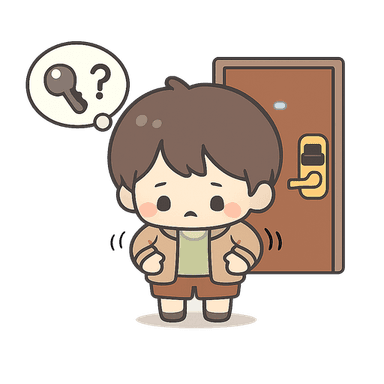
I lost my key
How it works
Polite completed action reporting an unfortunate past mishap with なくしました.
Mental Model: The Polite Past Time Stamp
In Japanese, tense is fundamentally binary: non-past (habitual or future action: 〜ます) versus past or completed (perfective reality: 〜ました). When an action has occurred and reached completion before the present moment, attaching 〜ました to the verb stem anchors it firmly in the past while maintaining the respectful social buffer of polite language (丁寧語, teineigo).
Whether reporting what you ate for lunch, recounting where you traveled on the weekend, or confirming that you received a colleague’s message, 〜ました is the gold-standard ending for polite conversation in schools, offices, shops, and casual professional encounters.
How to Attach 〜ました
Because 〜ました belongs to the ます-family, it attaches to the exact same base: the verb stem (連用形, ren'yōkei). Once you know how to make the 〜ます form, creating the past tense requires simply swapping ます for ました:
- Group 1 (Godan / Consonant-stem): Shift the final dictionary syllable from the u-row to the i-row, then add ました:
- 飲む (nomu, drink) → 飲み + ました = 飲みました (nomimashita)
- 書く (kaku, write) → 書き + ました = 書きました (kakimashita)
- 話す (hanasu, speak) → 話し + ました = 話しました (hanashimashita)
- 行く (iku, go) → 行き + ました = 行きました (ikimashita)
- Group 2 (Ichidan / Vowel-stem): Drop the final る, then add ました:
- 食べる (taberu, eat) → 食べ + ました = 食べました (tabemashita)
- 見る (miru, see/watch) → 見 + ました = 見ました (mimashita)
- 起きる (okiru, wake up) → 起き + ました = 起きました (okimashita)
- Group 3 (Irregular verbs):
- する (suru, do) → しました (shimashita)
- 来る (kuru, come) → 来ました (kimashita — notice the stem vowel shifts to ki)
Completion vs English Past Tense
While 〜ました usually maps to English simple past (“did”, “went”, “ate”), in Japanese it is fundamentally an aspect of completion (perfective aspect). It marks that an event or recognition has crossed the threshold into reality:
- Physical actions completed in the past: 昨日、7時に起きました。 (”Yesterday, I woke up at 7 o'clock.”)
- Immediate realization or sudden understanding: あ、分かりました! (”Ah, I understand now! / I've got it!”) Even though you understand right now in the present, the moment of grasping the concept just completed, which is why Japanese speakers say 分かりました rather than 分かります.
- Inquiries about completion: もう昼ご飯を食べましたか。 (”Have you eaten lunch already?”) Here ました matches the English present perfect (“have eaten”), because the focal question is whether the act is finished.
The Two Major Foreigner Traps
- Trap 1: Attaching ました to Adjectives:
A very common beginner mistake is saying
*美味しいましたor*静かました. In Japanese, adjectives conjugate completely differently from verbs! - For i-adjectives, the past is formed by dropping い and adding かったです: 美味しかったです (”It was delicious”), NOT
*美味しいました. - For na-adjectives and nouns, the past is formed with でした: 静かでした (”It was quiet”), NOT
*静かました. - 〜ました is strictly and exclusively reserved for verbs.
Conjugation
| Base form | Conjugated | Form |
|---|---|---|
| 食べる | 食べました | ichidan |
| 飲む | 飲みました | godan |
| 行く | 行きました | godan |
| する | しました | irregular |
In Dialogue
- ASpeaker A
昨日何をしましたか。
What did you do yesterday?
- BSpeaker B
友達と映画を見ました。
I watched a movie with my friend.
Completed past action with ました
Quick Check
Choose the correct sentence for: “Yesterday I bought a book at the bookstore.”